



A smooth, even Candle surface is not achieved by pouring wax into a container and simply waiting for it to harden. It depends on how the wax is prepared, how accurately the pouring temperature is controlled, how the Candle cools, and whether surface imperfections are corrected before final inspection. For wholesale Candles, these factors are particularly important because buyers expect consistent appearance across hundreds or thousands of units in the same order.
In commercial candle production, manufacturers use controlled wax heating, accurate temperature measurement, careful pouring, stable cooling conditions, and finishing procedures to create a clean surface. The exact process varies according to wax composition, candle shape, fragrance load, and production requirements. Understanding these variables helps importers and wholesalers evaluate product quality and communicate more effectively with manufacturers.
How Do Manufacturers Make Candle Surfaces Smooth and Even?
Manufacturers achieve a smooth candle surface by controlling the wax's transition from liquid to solid. During this process, wax contracts and develops a crystalline structure. If the temperature changes too quickly or unevenly, the finished surface may develop dents, air holes, cracks, frosting, or rough patches.
Several production controls work together to prevent these problems.
Wax Melting and Preparation
The process begins with selecting and preparing the wax. Paraffin, soy wax, beeswax, coconut wax, and blended waxes have different melting characteristics and cooling behaviors. A manufacturer must follow the recommended temperature range for the selected wax rather than applying one heating setting to every formulation.
Wax is heated until it becomes fully liquid and is mixed to achieve a consistent composition. Fragrance oils and colorants are introduced according to the formulation requirements. Insufficient mixing may cause uneven color distribution, while aggressive stirring can introduce air into the wax. Trapped air may later appear as small holes or bubbles on the finished surface.
For example, soy wax is particularly sensitive to cooling conditions. Its natural crystallization behavior can produce a white, uneven appearance known as frosting. This does not necessarily indicate poor candle performance, but it can affect the visual consistency expected in retail products.
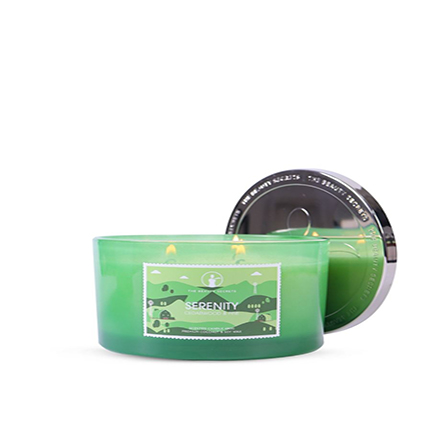
Accurate Pouring Temperature
Pouring temperature is one of the most important factors affecting surface quality. If the wax is poured at an unsuitable temperature, it may begin solidifying too early or experience excessive temperature differences after entering the container.
Wax poured too cool may not flow evenly across the container, creating an irregular top or visible pouring marks. Wax poured too hot may experience greater contraction during cooling, increasing the possibility of sinkholes and surface depressions.
A professional production team uses calibrated thermometers to monitor wax temperature before pouring. The appropriate temperature depends on the wax supplier's specifications, fragrance formulation, container material, and production environment. Manufacturers should establish a tested temperature range for each product rather than rely on visual judgment.
Controlled Cooling and Solidification
After pouring, candles need sufficient time to cool and solidify under stable conditions. Uneven cooling can cause different areas of the wax to contract at different rates. For example, a container placed directly on a cold work surface may lose heat faster through its base than through its sides.
Commercial production facilities can reduce this variation by keeping candles away from strong air currents, cold surfaces, and sudden temperature changes. Containers may also be preconditioned when the wax and vessel temperature difference is likely to affect the finished result.
Cooling should not be rushed simply to increase production speed. A candle that appears solid on top may still contain warmer, softer wax underneath. Moving or packing it too early can damage the surface or create deformation.
Surface Finishing and Final Inspection
Once the wax has solidified, manufacturers inspect the top for visible imperfections. Minor unevenness can sometimes be corrected by carefully reheating the surface with controlled hot air. The thin wax layer melts again and settles into a flatter finish.
For container candles with deeper depressions, a manufacturer may use a top-up pour. A small amount of compatible melted wax is added to fill the low area and create a level surface. The candle must then cool again under controlled conditions.
These finishing methods should be selected according to the defect. Excessive reheating can damage the appearance, disturb fragrance distribution near the surface, or affect decorative details. A well-managed factory therefore focuses on preventing defects during the main production process instead of depending entirely on rework.
Why Do Some Candles Develop Rough, Uneven, or Sunken Surfaces?
Surface defects usually indicate that one or more production variables were not properly controlled. Identifying the actual cause is more effective than simply changing the wax or applying additional finishing work.
Wax Shrinkage Creates Sinkholes
Sinkholes are depressions or cavities that develop as wax cools and contracts. In container candles, the outer areas may solidify before the warmer wax in the center. As the center continues cooling, its volume decreases and a visible depression can appear around the wick or across the top.
Consider a batch of wide-mouth Glass Candles. If the first pour looks level but several units develop central depressions after cooling, the production team should examine the cooling profile and wax formulation. A controlled top-up pour can restore the surface, while adjustments to pouring and cooling conditions may reduce the occurrence in subsequent batches.
For large-volume orders, buyers should ask whether the factory has a defined procedure for identifying and correcting sinkholes. A surface that looks acceptable immediately after pouring should not be treated as final until the candle has cooled completely.
Rapid Cooling Causes Cracks and Uneven Texture
Rapid or inconsistent cooling can produce cracks, rough patches, and visible changes in wax texture. This is particularly relevant to vegetable wax blends, whose crystalline structure can be sensitive to temperature changes.
For example, placing newly poured candles near an air-conditioning outlet or using refrigeration to shorten production time may cause the outer wax to solidify much faster than the center. The resulting temperature difference can create surface stress and uneven solidification.
Manufacturers should maintain consistent cooling conditions and avoid unnecessary movement during solidification. A stable production environment is especially important when the order includes multiple batches that need to look alike.
Air Bubbles and Poor Mixing Affect Surface Appearance
Air can enter melted wax during mixing, fragrance addition, or pouring. If these bubbles remain trapped as the wax solidifies, they may create small holes or rough spots on the surface.
Slow, controlled stirring and steady pouring help reduce unnecessary air introduction. The production team should also check whether the fragrance oil and colorants are compatible with the selected wax formulation. Different ingredients can influence the wax's consistency and final appearance.
When a batch repeatedly develops bubbles in similar positions, the factory should review its mixing and pouring procedures rather than treating every affected candle as an isolated finishing problem.
How Does Wax Type Affect the Smoothness of a Candle?
Different wax materials do not produce identical surface finishes under the same manufacturing conditions. This is an important consideration when sourcing wholesale candles for different retail markets and product positioning.
| Wax Type | Surface Characteristics | Manufacturing Considerations |
|---|---|---|
| Paraffin Wax | Can produce a relatively smooth and uniform finish. | Requires suitable pouring and cooling conditions to reduce shrinkage marks and surface defects. |
| Soy Wax | May develop frosting or uneven crystalline textures. | Cooling consistency and formulation testing are important for visual uniformity. |
| Beeswax | Can have a natural texture and color variation. | Material purity, temperature control, and mold conditions influence the final appearance. |
| Coconut Wax Blends | Can provide a creamy, smooth-looking finish depending on the blend. | Performance depends on the specific formulation and its compatibility with fragrance and colorants. |
These characteristics are general tendencies, not guaranteed results. A well-formulated soy wax candle may have a more consistent finish than a poorly controlled paraffin candle. The manufacturer's formulation knowledge and production controls are just as important as the raw material itself.
What Quality Checks Help Ensure Consistent Candle Surfaces?
For B2B orders, surface inspection should be part of a repeatable quality control process. Buyers are not only purchasing an attractive sample; they need finished products that maintain a consistent appearance throughout the shipment.
Visual Inspection Under Consistent Lighting
Inspectors should examine candle tops under consistent lighting to identify dents, cracks, air holes, frosting, foreign particles, and uneven color. Comparing finished units with an approved sample helps establish a shared visual standard between the buyer and manufacturer.
For example, a retail brand ordering 2,000 candles in the same glass container may require a consistent wax level, a centered wick, and a smooth top. If the first production batch has a different surface appearance from the approved sample, the factory should investigate the cause before continuing with the remaining quantity.
Surface Level and Fill-Level Verification
Surface smoothness and fill level should be checked separately. A candle can have a flat top but still contain too much or too little wax. Conversely, a correctly filled candle may have a visible depression around the wick.
Manufacturers can use reference measurements, weighing procedures, and visual inspection to check fill consistency. For container candles, the distance between the wax surface and the container rim should follow the buyer's approved specification.
Batch Sampling and Production Records
Inspecting only one finished candle is not enough to establish consistency across a large order. Factories should inspect samples from different production stages and record relevant process conditions, including wax batch, formulation, pouring temperature, and cooling conditions.
If defects appear during inspection, these records help the production team trace the source of the problem. For buyers, a documented inspection process also makes it easier to evaluate whether the supplier can maintain consistent quality across repeat orders.
How Can Buyers Evaluate a Wholesale Candle Manufacturer?
When sourcing candles in bulk, buyers should look beyond product photographs and unit prices. The manufacturer's ability to control surface quality throughout production is a more meaningful indicator of whether the finished order will meet retail expectations.
Before confirming an order, buyers can ask the factory several practical questions:
Does the factory have tested pouring and cooling procedures for different wax formulations?
How does its production team handle sinkholes, frosting, cracks, and air bubbles?
Are surface appearance and fill level included in the final inspection?
Can the factory provide samples from the actual production batch?
Can it maintain the same surface finish across repeat orders and different fragrance variations?
These questions are especially useful for private-label and OEM projects. A reliable wholesale candle manufacturer should be able to explain how its production process supports the requested appearance, rather than simply promising that every candle will look perfect.
Buyers working with a wholesale candle factory should also confirm the acceptable level of natural wax variation. For example, a brand selling soy candles may need to distinguish between normal frosting and unacceptable surface damage. Defining these standards before mass production helps avoid disagreements during final inspection.
A capable wholesale candle supplier should also understand the relationship between appearance, formulation, and burning performance. A smooth surface alone does not prove that a candle has the correct wick size, stable flame, suitable fragrance release, or consistent burn behavior. Appearance checks should therefore be considered alongside product performance testing.
Conclusion
Smooth and even candle surfaces are the result of coordinated manufacturing controls, including wax preparation, accurate pouring temperature, controlled cooling, and appropriate surface finishing. Sinkholes, frosting, cracks, and air bubbles can often be traced to specific material or process conditions, making consistent production records and quality inspections essential.
For overseas importers, wholesalers, and private-label brands, choosing a manufacturer with reliable process control is more important than judging quality from a single sample. When evaluating wholesale candles, buyers should confirm the factory's ability to reproduce the approved surface finish across the full order while maintaining consistent fill levels and burning performance.
Frequently Asked Questions
Can all candles have a completely smooth surface?
Not necessarily. The final appearance depends on wax composition, fragrance, colorants, and cooling conditions. Natural waxes such as soy may develop frosting due to crystallization. Manufacturers can reduce certain imperfections, but some natural variations may remain.
Does a rough candle surface affect burning performance?
Minor cosmetic imperfections do not automatically affect burning performance. However, significant cracks, internal voids, or formulation inconsistencies may require further inspection. Buyers should evaluate surface appearance separately from wick performance and burn testing.
Can manufacturers correct uneven candle tops after production?
Yes. Minor roughness may be corrected through controlled surface reheating, while deeper depressions can sometimes be repaired with a compatible top-up pour. However, prevention through proper temperature and cooling control is generally more efficient for large production orders.